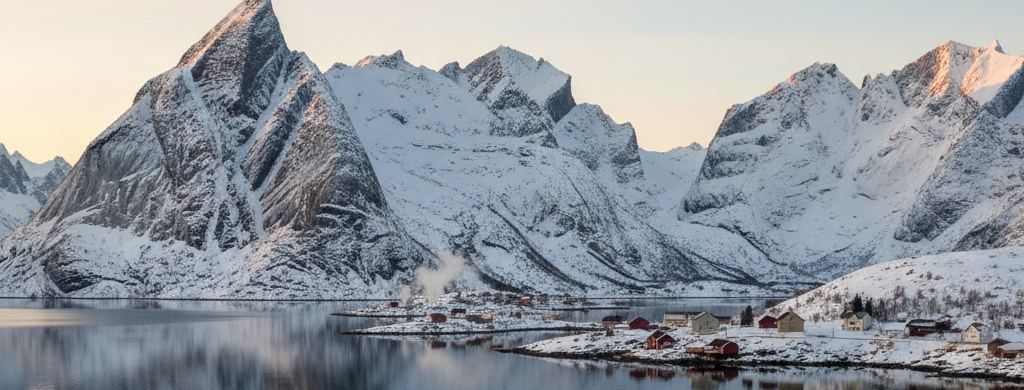
Granite walls out of black water, six usable hours of light
Above the Arctic Circle you reserve a six night late winter week in Lofoten
From $2,740 per person, two sharing a double room, for six nights between late January and mid March. The spread is very wide, the widest the office prints. In this season the difference between the two versions below is not a matter of comfort: it is the difference between seeing the islands and sitting inside a heated cabin listening to the roof. Same dates, same figure.
Reserve one of these weeksSend the form whenever it suits: it never shuts. Someone here replies inside one working day, and no charge arises at this end.
One week, written out twice
One set of dates, one set of rooms, the same guides and the same $2,740. The variable is the place itself, which answers to nobody here. Both readings appear below because both are real.
At its best
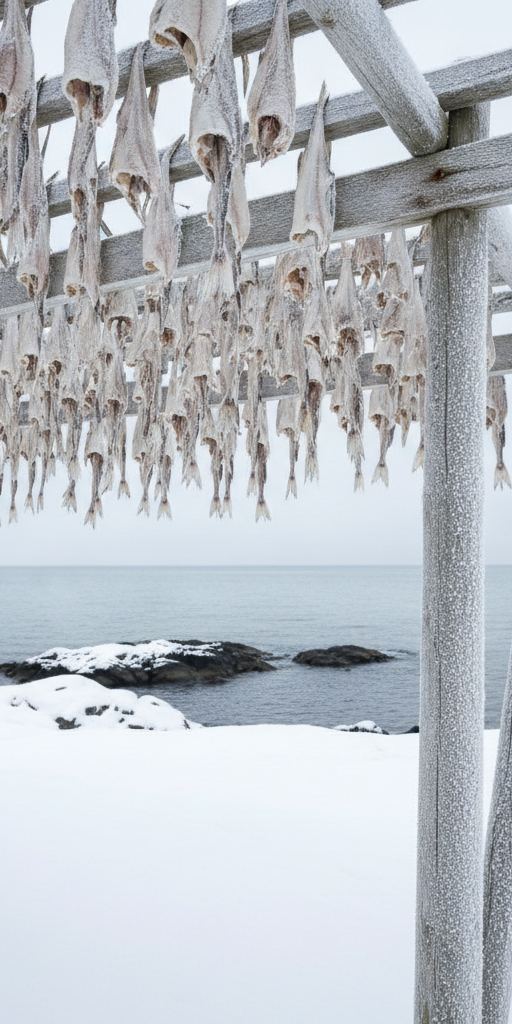
At its best the wind drops and the water in the fjord arms goes flat enough to hold the whole wall upside down. Sunrise and sunset run into each other from about half past nine until three, so the peaks stay in low orange light for five hours at a stretch and there is no bad hour to be outside. You walk out to a white sand beach on the north side with your own tracks the only ones on it. Racks of split cod stand along the shore, stiff with frost, and the smell reaches you before the racks do. Roads stay open. If the sky clears after ten, something green may stand over the ridge for twenty minutes, which nobody arranged and nobody can. You are in a heated wooden cabin on the water each evening.
At its worst
At its worst a deep depression parks over the islands and stays for the whole six nights. Wind runs at gale force along the outer coast, the road over the exposed stretch closes for hours at a time, and the boat excursion the local company runs is off from Monday. Cloud sits on the ridge line so the walls you came for are a grey suggestion above the water, and daylight, already short, never brightens past dusk. You do not see the sky do anything at night, not once. Snow arrives sideways and wet. What still stands: the cabin, the food, the driver, the guide, the fishing village itself, and a coast that is worth looking at in any weather. You pay $2,740 and you photograph rain on a window.
Lofoten is a chain of islands off northern Norway, inside the Arctic Circle, where a mountain range that runs mostly underwater comes up for about a hundred miles. The peaks are gabbro and granite, three thousand feet at the highest, and they stand more or less straight out of the sea with a strip of flat ground at the foot. That strip holds everything: the fishing villages, the road, the beaches of pale sand, the sheep fields. Warm ocean water keeps the sea free of ice and the air far milder than the latitude suggests, which is why anyone lives here at all. In late winter the peaks are white, the fields are brown or snowed over, and the whole place is running on about six hours of light.
How six short days are spent
Tall wooden racks hung with split dried cod, frost on the timbers, snow behind
Nothing starts early, because nothing can. Breakfast is unhurried, the minibus leaves around nine as the sky begins to color, and you are outside for the four to six hours that are worth being outside. Two days are walks of three to five miles on the coast, low and not technical, on snow or wet rock depending. One day is spent along the drying racks and the harbors of two villages, which is where the working island shows itself: tonnes of split cod hung on timber frames to dry in cold air, the same method for eight hundred years. One day is kept clear and decided the night before. Evenings are indoors by four. If the sky does something after ten, the guide knocks on doors.
Money, nights and what sits outside
From $2,740 per person, two sharing a double room, holds six nights in a converted fishermen's cabin on the water, breakfast daily, four evening meals, a guide and driver for five days, and all road transport inside the islands. Outside the figure: getting to Norway and back, which is your own booking, because this office arranges no air and no sea travel and holds a contract with no carrier; winter clothing hire, which the operating company charges on arrival; any water excursion, which is the ground company's own and is charged by it; drinks; and travel insurance, which this office neither sells nor advises on. The company running the week issues the invoice under its own name. Nothing is taken at this end and no card is seen here.
Nights
6
From
$2,740 per person, two sharing
When it runs
late January to mid March
Spread between the two versions
Very wide
What the figure holds
Rooms for the nights stated, the guided days set out on this page, admissions belonging to those days, and whatever the running company charges for its own part.
What it leaves out
Reaching the country and leaving it again, any meal not listed above, anything personal, and anything agreed later.
Who invoices you
The company that runs the week, in its own name.
Asked before anybody commits
Will I see the northern lights?
Nobody can answer that, and this office will not pretend to. The lights need clear sky and a solar event at the same time, neither of which is on sale. No figure on this page is discounted or raised for the sky, no version of the week is called likely, and if you are booking six nights only for that reason, the office would rather you knew it is a gamble before you send the request.
How cold does it actually get?
Milder than the latitude suggests and wetter than people expect. Records for this coast in February commonly run between about twenty and thirty four Fahrenheit, though any given week can sit outside that. Wind and wet are the problem rather than deep cold. The operating company hires out an insulated outer layer and boots on arrival, charged separately. Bring layers you can walk in for five hours.
Can I move the week if the forecast looks bad?
No. Dates are held with the operating company months ahead and are not moved on a forecast, by this office or by anyone else. Change terms are the operating company's own and are sent to you in writing before you commit to anything. If forecast chasing is how you prefer to travel, book at three weeks notice instead and accept that the beds may not exist.
Finish the sentence and a week gets reserved
Whatever the hour, what you send lands here and is read by a person, who replies inside one working day. Sending it binds you to nothing, and no sum is ever taken at this end.