Stripped oak trunks, wheat stubble, whitewash and a wide sky
Walking between fortified villages, you reserve a seven night cork country week in the Alentejo
From $1,490 per person, two sharing a double room, for seven nights in April, May, or from late September into October. The spread is moderate. The two weeks below are recognizably the same holiday: what the bad one costs you is comfort, color and a couple of hours a day, not the trip itself. It sits among the narrower spreads this office prints.
Reserve one of these weeksSend the form whenever it suits: it never shuts. Someone here replies inside one working day, and no charge arises at this end.
One week, written out twice
One set of dates, one set of rooms, the same guides and the same $1,490. The variable is the place itself, which answers to nobody here. Both readings appear below because both are real.
At its best
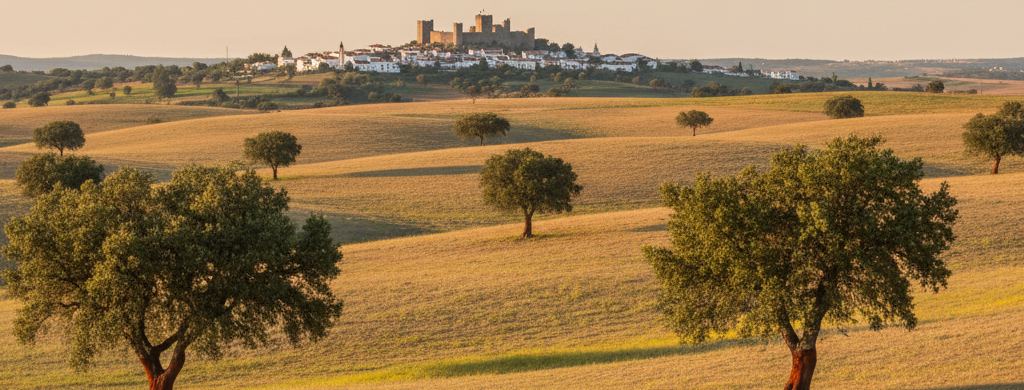
At its best the plain is green under the oaks and the ground between them is solid flower: yellow bermuda buttercup in sheets, blue lupin, wild gladiolus in the wheat. Mornings start at fifty five degrees and it is sixty eight by lunch, which is walking weather and nothing more. You cross three or four estates a day on cart tracks, passing cork oak stripped to a rust red band on the trunk, black pigs working the acorns, and nobody at all for two hours at a time. Storks are on chimneys and pylons through the villages. Villages sit on the only hills there are, walled, with a castle on top and marble curbstones, and you arrive at four with time to sit in the square before the shade goes.
At its worst
At its worst the heat comes three weeks early and the same walk is done between eighty six and ninety five degrees with no shade for an hour at a stretch. Flowers are over by the second week of May in a dry year, so the ground under the oaks is straw and dust instead of yellow. Starts move to six thirty to beat the afternoon, which means breakfast in the dark and everyone finished and flat by two. In October the reverse: rain turns the clay tracks to something that adds five pounds to each boot, and two river crossings become fords you will not attempt. What still stands: the oaks, the villages, the marble, the food, the guide, the beds and the figure. The walk happens. It is simply harder and browner than the photographs.
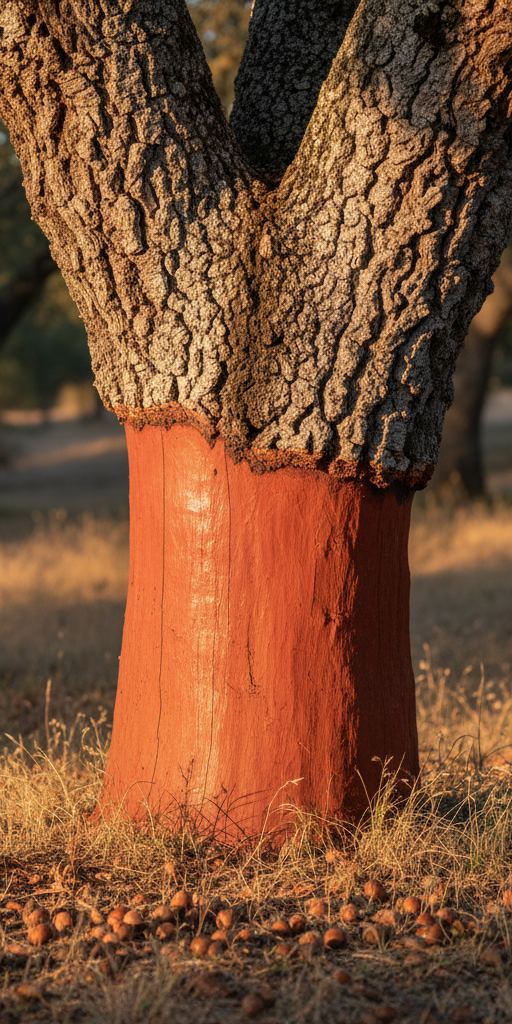
Close upright view of a cork oak trunk stripped bare, rust red under rough grey bark
The Alentejo is the third of Portugal south of the Tagus and it is mostly flat, mostly dry and almost empty: about seven people to the square mile in places. The land is worked as montado, oak savannah managed by hand for a thousand years, grazing under widely spaced cork oak and holm oak. Cork is stripped from the same trunk every nine years, in summer, by hand with an axe, and the tree is unharmed and lives two centuries. A stripped trunk is rust red for a year, then darkens. Between the oaks are wheat, olives and pig. On the low hills sit the walled villages, whitewashed with yellow or blue trim, most of them fortified in the thirteenth century when this was a border.
How the seven days are built
Seven nights in four villages, moving on foot on five of the days, with luggage carried on by road. Stages are eight to thirteen miles on farm track, drover's road and a little tarmac, flat to gently rolling, with under a thousand feet of climb on the biggest day. There is one rest day in a marble town, with a castle, a bone chapel and a Roman temple within ten minutes walk of the room. Navigation is on a printed route sheet, with a local guide on three of the stages. Nothing is remote in the alpine sense, but the gaps between villages are real: you will go three hours without a shop, a tap or shade.
Inside the price and outside it
From $1,490 per person, two sharing a double room, holds seven nights in village guesthouses and one converted farm, breakfast every day, four evening meals, luggage moved between each village, route sheets, and a guide on three stages. Left out of it: reaching Portugal, which you arrange yourself, given that nothing airborne or seagoing is handled here. Whichever firm runs the week invoices under its own name, and this end is settled with once you are back. Nothing is paid here and no card details are held here.
Nights
7
From
$1,490 per person, two sharing
When it runs
April, May, then late September to October
Spread between the two versions
Moderate
What the figure holds
Rooms for the nights stated, the guided days set out on this page, admissions belonging to those days, and whatever the running company charges for its own part.
What it leaves out
Reaching the country and leaving it again, any meal not listed above, anything personal, and anything agreed later.
Who invoices you
The company that runs the week, in its own name.
Asked before anybody commits
Will the flowers be out when I come?
Unknown, and the office will not guess for you. Flowering runs on winter rain and on how fast the heat arrives, both of which are settled long after you book. A dry March can finish the display before the second week of May and a wet one can hold it into June. If a specific week has to have flowers in it, do not book this one.
Can I watch the cork being stripped?
Almost certainly not, and it is better said here than at the door. Stripping is done in June, July and August, when this walk does not run, because the plain is at a hundred degrees. You will see stripped trunks, stacked slabs of bark drying in yards and the cycle year painted on the bark, but not the work itself.
How much of the week is actually on foot?
Five walking days out of seven, forty five to fifty five miles in total, plus one rest day and one arrival day. Luggage never goes on your back. If a stage looks too long on the morning, the operating company moves your bag and you with it by road, and you rejoin the route the next day at no extra charge.
Finish the sentence and a week gets reserved
Whatever the hour, what you send lands here and is read by a person, who replies inside one working day. Sending it binds you to nothing, and no sum is ever taken at this end.